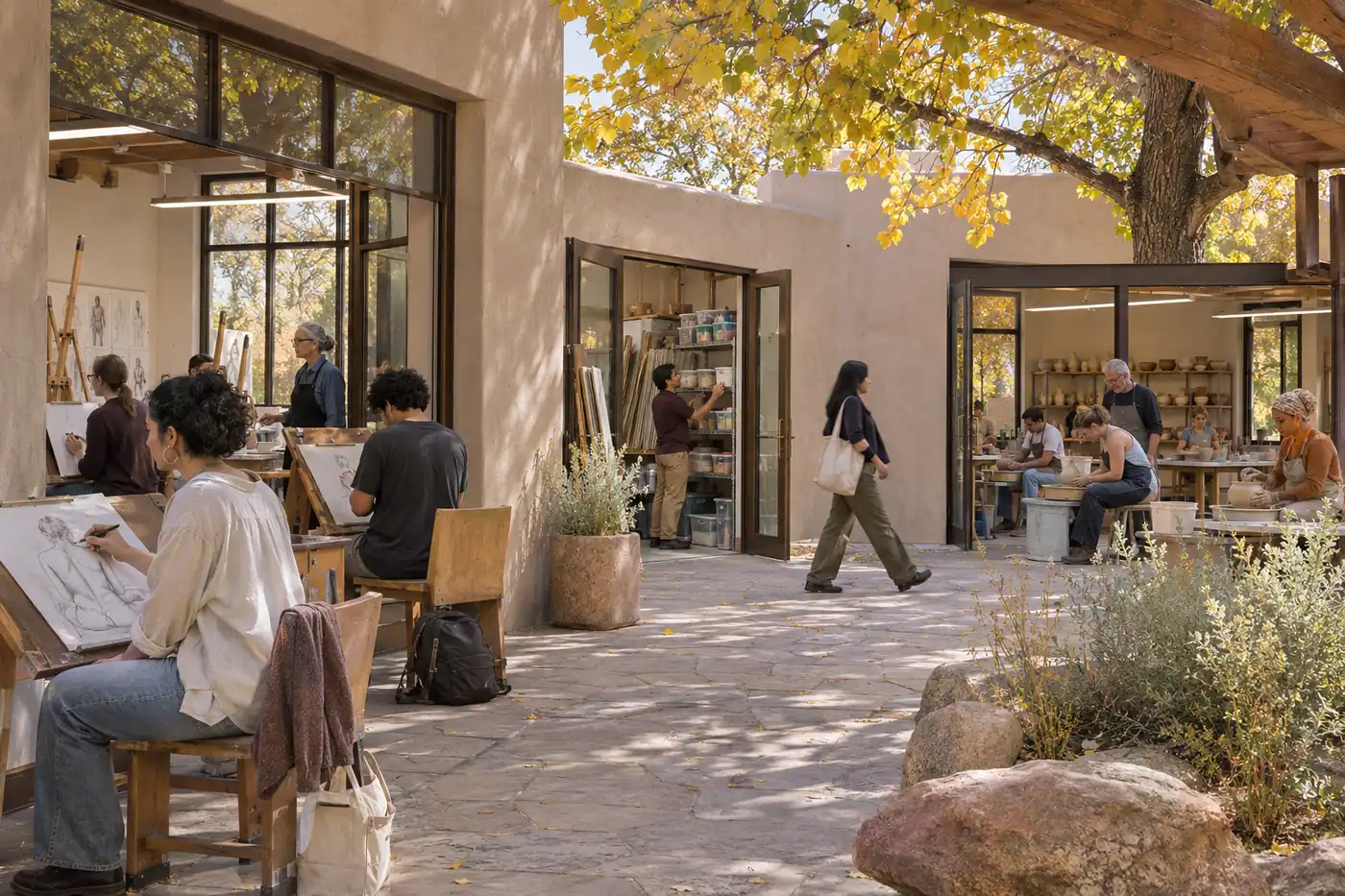
From a teaching studio to a connected campus.
Cobre Mesa began in 1986 as a shared teaching studio with drawing, clay and evening writing workshops. Its development followed a recurring need: give a creative practice enough time, context and usable feedback to become more sustained. The later undergraduate curriculum kept that practical beginning while adding a full sequence of contextual and degree study.
Community artists establish a shared teaching studio with drawing, clay and evening writing workshops.
Arroyo Studios brings material practice and shared critiques into one courtyard.
The college introduces its four-year arts curriculum and a common first-year foundation.
Northlight Media Center and Cinder Black Box add dedicated production and performance spaces.
Folio Library expands its writing room and the college introduces cross-disciplinary final-project conversations.
A common language without one common outcome.
The foundation asks students to observe carefully, preserve a useful record, offer specific feedback and take responsibility for a shared space. These habits can connect a ceramic series to a piece of writing without making either practice a version of the other.
The college’s mission is to help emerging artists develop a sustained practice through making, critical exchange and the thoughtful presentation of work. The practical test is whether a student can show the choices behind a project and identify a meaningful next step.
The present is a working campus.
Today the courtyard connects material studios, Northlight Media Center, performance rooms, Folio Library and places to spend an ordinary day. Student work enters a public setting through Mesa Gallery, small performances and original readings. Those settings add selection, credits, access and visitor information to the work of the studio.
The eight degrees share contextual study, but their final projects remain distinct. A film includes production credits and a notebook; a ceramic series carries a material archive; a literary manuscript includes an editorial and revision account. This connection between work and record remains a teaching priority.