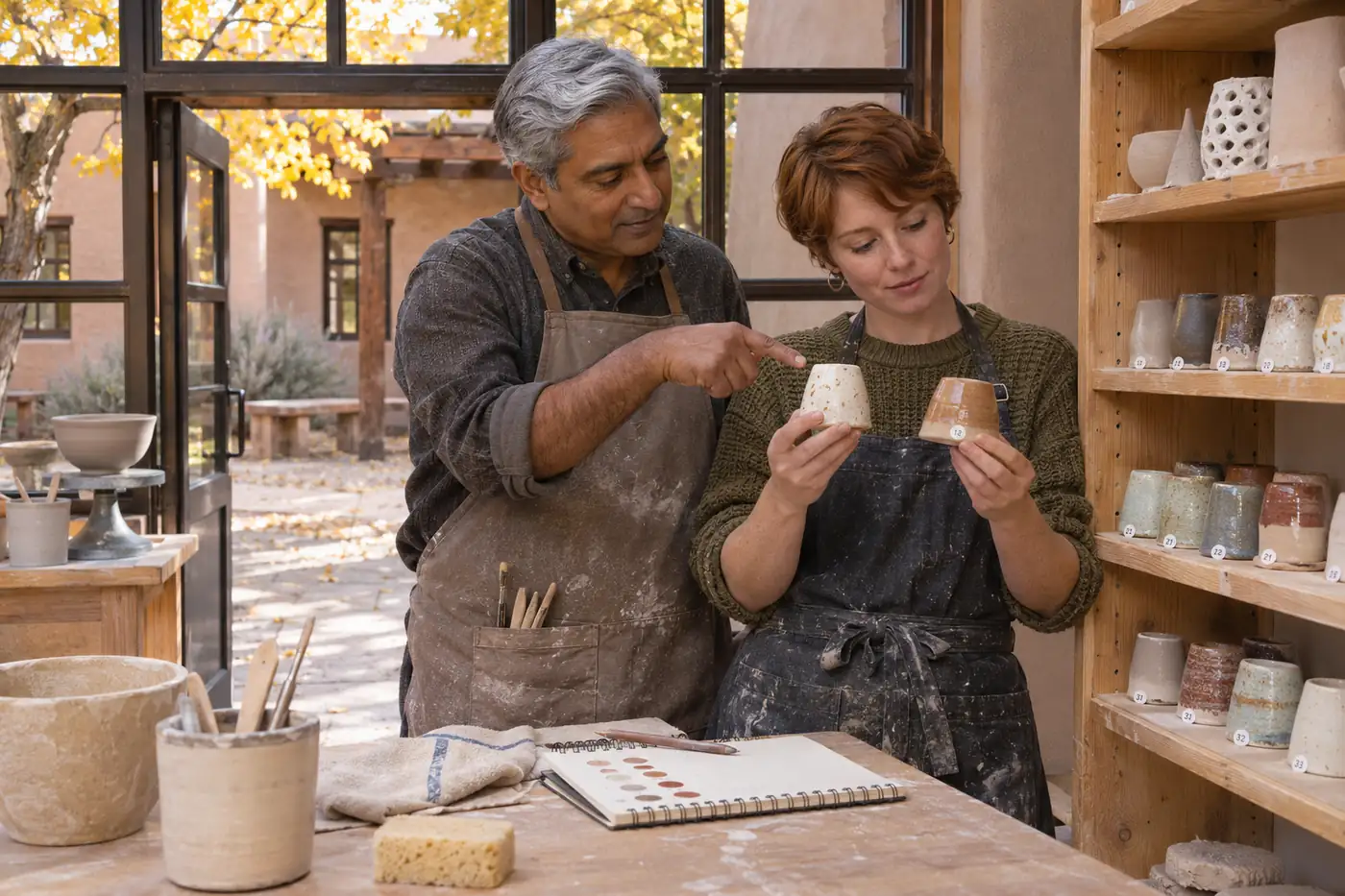
A shelf of decisions
A new teaching shelf in Arroyo Studios gathers small clay and glaze tests produced during the opening weeks of the ceramics sequence. Each piece is labelled with a sample number linked to a student’s notebook. The shelf is intended as a reference for course discussion, not a commercial product display or a claim that a particular finish is suitable for every use. Its value lies in the relationship between a visible result and a readable account of how it was made.
Keeping variables visible
Gabriel Rios asked students to keep one part of a test steady while changing another. Groups compared a surface across one clay body, then looked at how a different form affected the same surface. Tests that did not meet a student’s intention were retained alongside the stronger results. The notebook records preparation and the supervised firing context, making it easier to distinguish a useful comparison from two unrelated samples.
From sample to series
The shelf connects foundation material exercises with the larger series developed later in the program. During a studio discussion, students arranged their tests beside drawings of the objects they hoped to make. A sample that looked promising alone did not always support the intended rim, handle or sculptural edge. That mismatch became a reason to revise the form or repeat a test, rather than hide the less successful piece.
Shared space and responsibility
The reference shelf occupies a teaching area outside the supervised kiln room. Students may look at the labelled tests during ordinary studio hours, but equipment access still requires the relevant induction and staff agreement. Borrowing a sample for discussion is recorded through the Studio Care Desk so that it can be returned to its place. The display labels intentionally avoid replacing course instructions or presenting a firing record as general technical advice.
Reading the record
Students using the shelf for a class presentation should cite the sample maker and explain the specific question the test addresses. Rios will review the first collection at the end of the term, keeping a small selection for future teaching and returning the remaining work to students. The Ceramics & Material Practices page describes the progression from beginning form studies to a final series with a coherent material archive.
What a label needs
A useful label gives the maker, sample number and the notebook location of the supporting record. It should not squeeze an entire technical procedure onto a small tile or invite another student to repeat a process without supervision. When a test is moved into a presentation, the connection to its original record stays with it. Students discussing the collection next term will therefore be able to ask what was compared, what remained uncertain and why a particular test was retained as a teaching example.