A working notebook is a place to start.
The first year gives students shared ways to observe, test and discuss work across disciplines. A notebook can hold a drawing, a movement pathway, a changed sentence or a sequence of images. Its purpose is to preserve a decision clearly enough that you can return to it and make a useful comparison.
The foundation is not a demand to make every student work in the same medium. Tasks are modest and adaptable, helping a writer examine sequence or a musician notice spatial relationships while major studios develop the program’s own methods.
Observation and materials.
FND 101 · Observing & Making
Drawing, notation and material studies help students slow down observation and turn it into testable creative decisions. Each exercise includes a short account of what changed.
3 credits · A sequence of observation studies and a working notebook.
FND 102 · Materials & Process
Students test paper, clay, found objects and temporary construction methods. Emphasis falls on preparation, safe handling, reversible experiments and useful process records.
3 credits · A material sample collection and process log.
Sequence, time and space.
FND 110 · Image & Sequence
Still images and simple sequences introduce framing, rhythm and juxtaposition. Students compare a single image with its effect in a longer sequence.
3 credits · A six-image sequence and revised presentation.
FND 120 · Time, Body & Space
Movement, duration and the arrangement of a room become shared starting points for students from every discipline. Tasks can be adapted through different forms of participation.
3 credits · A short spatial study with an observation record.
Returning to critique and presentation.
FND 201 · Critique & Collaboration
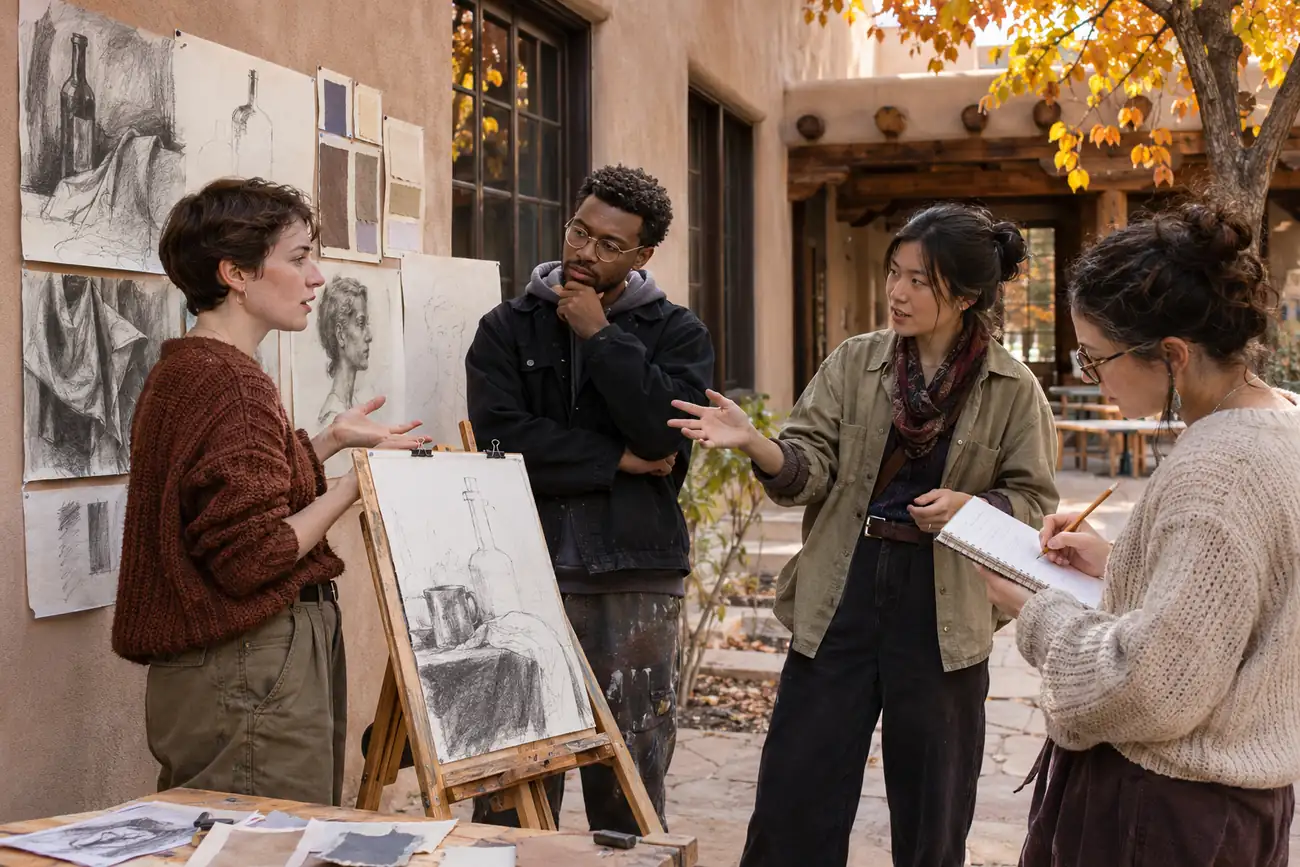
Students practice describing work, asking a specific question and separating suggestion from judgment. A small collaborative assignment makes responsibilities and revision decisions visible.
3 credits · A collaboration agreement and a documented revision.
FND 202 · Presenting a Practice
Students choose work, develop captions and artist statements, and consider the audience’s route through a presentation. Technical finish is evaluated alongside clear context.
3 credits · A selected-work presentation with captions and statement.
Different degrees, different foundation totals.
The BFA sequence carries 18 foundation credits: the first four courses begin the first year, with critique and presentation in the second. Music & Sound carries 20, including the two-credit Rhythm & Listening Laboratory. The literary BA requires 12 foundation credits and uses contextual study and approved electives to extend the practice.
A first critique starts with description before advice. Students identify what changed after the discussion and may explain why a suggestion does not fit the question being pursued. Student Support can discuss another way to participate before a session.